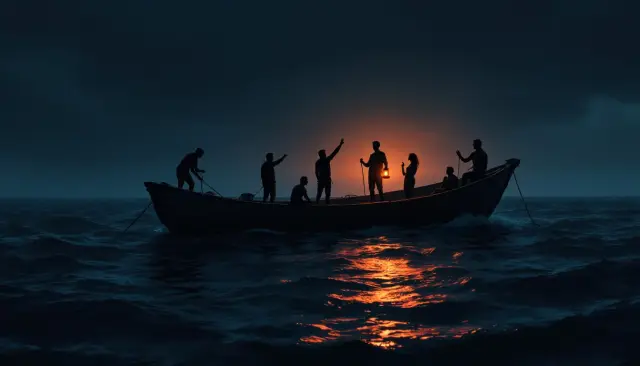
Could You Survive a Shipwreck?
The ship is going down and you have ninety seconds to decide. This quiz uses one brutal scenario to reveal exactly how you function when the stakes are as real as they get.
About this quiz
Not everyone falls apart when things go wrong. Some people get sharper, colder, more precise, and most of them only find out on the worst day of their lives. Could you survive a shipwreck? Answer that honestly and almost everyone hesitates, because the real answer has nothing to do with knots, first aid or upper body strength. It has to do with what happens inside your head when the deck tilts, the alarm won't stop and salt water starts making decisions for you. This could survive shipwreck quiz drops you into that hour and refuses to let you watch from shore.
Maritime disaster research keeps surfacing the same counterintuitive finding: technical knowledge matters far less than people assume. What separates survivors from the rest is psychological architecture, the internal structure you fall back on when the external one is underwater. The Cold Navigator turns terror into data. The Natural Leader starts organizing nine strangers before anyone thinks to ask. The Empathic Anchor keeps a lifeboat psychologically functional while everyone else quietly unravels. Same disaster, three completely different survival mechanisms, none of them taught in a safety briefing.
What extreme pressure actually reveals
The six profiles mapped here aren't personality types in the soft, self-congratulatory sense. They're behavioral signatures under real load. The Adaptive Survivor doesn't just cope with chaos, they think in materials and possibilities, seeing a fishing hook with no line as a problem worth solving. The Calculated Risk-Taker isn't reckless, they process what little information exists faster than most and move before certainty arrives. The Steady Endurer works in the register survival stories skip entirely: not the dramatic first hour, but day three, when the adrenaline is gone and all that's left is time, hunger and a mind that has started arguing with you. How do you know which one you are without an actual wreck? You put yourself in the scenario and watch your first instinct arrive uninvited.
How the could survive shipwreck test works
Fourteen questions place you on the ship, then in the water, instead of asking you to describe yourself from dry land. You decide what to do with your last flare when a shape on the horizon might be rescue and might be nothing. You decide who gets the only blanket on a freezing night, whether to push back against a plan you're certain is wrong, how you handle your own hunger once rationing bites. Fog splits the group into two rafts: one has the supplies, the other has the person you trust most, and you choose. Nobody hands you an obviously correct answer, and there's no way to game the scoring. Each choice is a small, specific stress test, and the pattern they form is what points to one of the six survivor profiles.
Those patterns don't stay at sea. They show up in meeting rooms, in hospital corridors, in the middle of arguments, in any situation where the stakes are real and the outcome is genuinely unclear. Finding your survival type is a way of discovering yourself with the rehearsed parts stripped off.
The ship is already listing. Ninety seconds to your first decision, six profiles waiting on the other side, and one honest way to find out whether you could survive a shipwreck: get in the lifeboat and see what's still standing when the water hits.
Frequently asked questions
How long does the Could You Survive a Shipwreck? quiz take?
About 5 minutes, no signup required.
Is the Could You Survive a Shipwreck? quiz free?
Yes. Every quiz on Quizzvibes is free and playable instantly.
Can I play the Could You Survive a Shipwreck? quiz with friends or as a couple?
Yes, three ways: as a challenge, your friends answer as you and the score shows who really knows you; as a couple, you each answer on your own and the quiz measures your compatibility; with friends, everyone gets their profile and one verdict for the group. Free, no signup.
What does the Could You Survive a Shipwreck? quiz reveal?
The ship is going down and you have ninety seconds to decide. This quiz uses one brutal scenario to reveal exactly how you function when the stakes are as real as they get.